
“CRAC” (Computer Room Air Condition) the Code
InfraMation 2010 Application Paper Submission
John Cannamela
ISC Building Diagnostics
Computer Room Air Conditioning (CRAC) units are essential for maintaining optimal environmental conditions in data centers and server rooms. These specialised systems are designed to regulate temperature and humidity, ensuring the reliable operation of critical IT equipment.
Regular maintenance of CRAC units is vital to prevent overheating and equipment failure. Key maintenance tasks include:
- Air Filter Replacement:
Dirty filters can overwork motors and reduce cooling capacity. Regularly replacing air filters ensures efficient airflow and prevents particulate accumulation on hardware.
- Condenser Coil Cleaning:
Condenser coils can draw in dirt, leading to reduced efficiency. Regular cleaning helps maintain optimal performance.
- Airflow Monitoring:
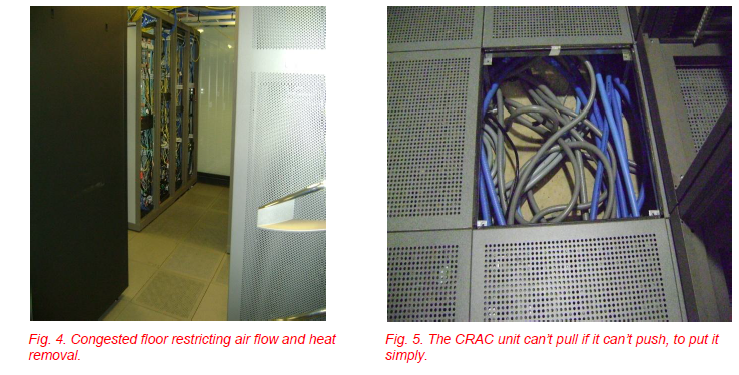
Ensuring proper airflow both below and above the floor helps identify hot and cold spots, maintaining consistent cooling.
How can IR technology help CRAC maintenance?
By incorporating infrared thermography into maintenance routines can enhance the detection of airflow issues and temperature anomalies, allowing for proactive adjustments to CRAC unit HVAC systems. This approach supports efficient cooling and prolongs the lifespan of both the CRAC units and the IT equipment they protect.
By adhering to these best practices, data centers can maintain optimal operating conditions, reduce the risk of equipment failure, and ensure energy-efficient operation of their CRAC units.
Here is a detailed example of a HVAC-CRAC unit testing procedure:
ABSTRACT
Data rooms have two main concerns: heat and dirt. Both are taken care of by the computer room air conditioning unit (CRAC). CRAC's are of constant concern; they heat, cool, dehumidify, and filter the air. The air distribution is a key factor in how well the heat is removed. Infrared can be a crucial part of the troubleshooting process.
INTRODUCTION
HVAC experience and theory combined with thermal imaging can combine to provide test and balance professionals and HVAC experts with quality information that can be used to identify a number of issues that commonly occur in data rooms. HVAC professionals know that diagnosis of these problems can be an art as much as a science and that any tool that provides information is valuable. Thermography is such a tool, and is very powerful if used correctly. Within its given limitations in HVAC applications, thermography has nearly unlimited potential.
HVAC-CRAC UNITS
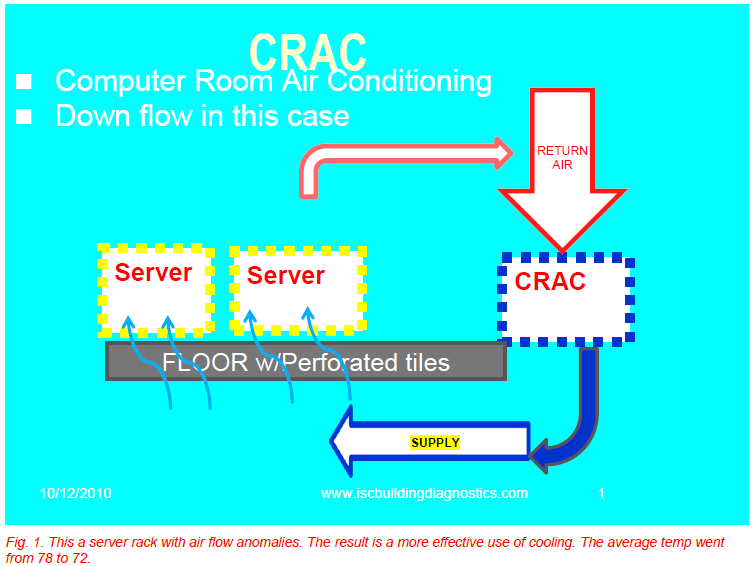
The performance of a HVAC-CRAC unit is affected not only by what is going inside the unit, but also by the system with which it is installed. Air flow from the unit is affected by factory settings and by the way in which it is tuned to the environment. This paper will focus on trouble-shooting with thermography.
Scenario: The IT manager says the system is under-sized, but in reality it may not be removing the tonnage required due to factors such as air flow, water flow, refrigerant piping, and filtration. Points to consider: Air is hard to control due to its low density. By control, I mean how heat is transferred to and from a given area. Since air is a low density fluid, it dissipates rapidly upon leaving a controlled containment. Air is forced through duct work or plenum with fans and is then circulated to transfer heat. Areas are designed for certain volume of air. This volume has to be distributed according to demand or load. This is where infrared thermography can be particularly effective in identifying problems. A given area or zone is filled by a quantity of fluid (air). The measurement and adjustment of this quantity is achieved by testing, adjusting, and balancing (TAB). We can accomplish these tasks with special tools such as a flow hood and thermometers, RH, etc. Reading and adjusting flow in a given area will give you proper volume for the load. However, volume and temperature measurements won’t give you effective air distribution.
Testing involves many instruments that measure temperature, volume, and velocity of fluids, including air. Air movement is a necessary requirement in buildings, but where and how it moves is not easy to control after it leaves the ductwork /plenum. We can use smoke to see air flow, but that technique can’t necessarily give us all the information we need in order to determine whether air quality or temperature is affecting comfort.
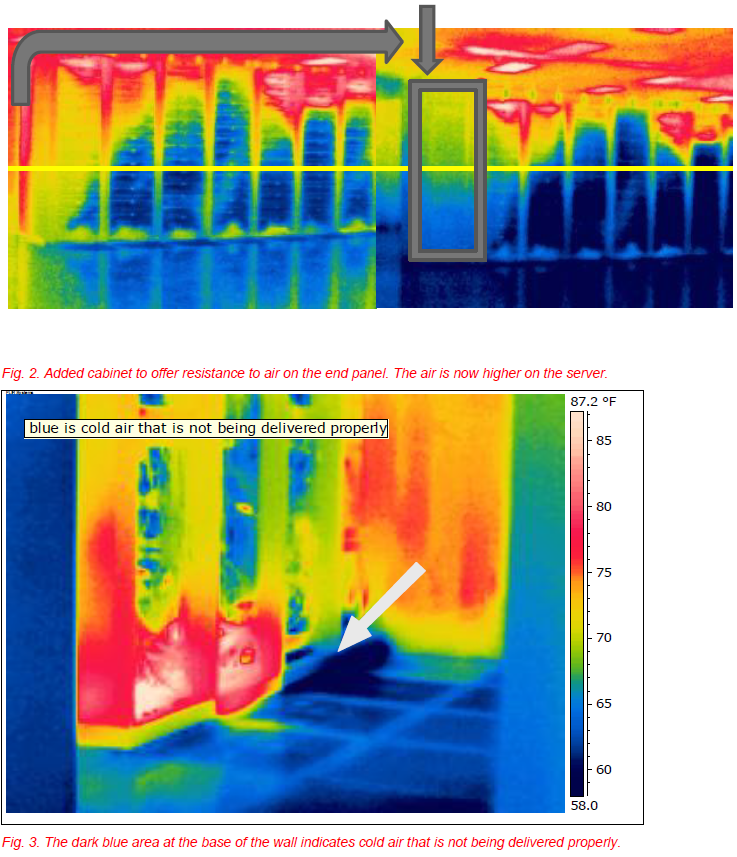
Infrared thermography allows us to see the effects of the air movement so that we can then direct it to a more beneficial area for comfort or process.
HVAC-CRAC UNIT TESTING PROCEDURE
In order to use infrared thermography to check air distribution, the air needs to be in cooling mode. The system should be at max flow demand.
1) The air should blow for a few minutes to see the effect on a given surface.
2) Air should be read with a velocity measurement tool.
3) IR should then be utilized to see what areas are being affected by the air.
This information will allow the IT manager or engineer to add or place perforated tiles or server racks, etc., as needed.
SUMMARY
Using infrared thermography combined with standard practices and tools saves time during the trouble shooting process which keeps the customer satisfied and on-line.
ACKNOWLEDGEMENTS
The author wishes to thank the Infrared Training Center at FLIR Systems.
ABOUT THE AUTHOR
John Cannamela is a Level II Thermographer, Level II Vibration Analyst, Level I Eddy Current, and a HVAC licensed journeyman
Related Articles
-
 sUAS/Drone
Aerial Solar Thermography and Condition Monitoring of Photovoltaic Systems
Read the Story -
 Electrical/Mechanical
Beware What You Cannot See: A Practical Application of the Use of IR Windows
Read the Story -
 Thermography Fundamentals
Geometry effects; hedging your bet on emissivity!
Read the Story