
Cooled Infrared Cameras with InSb Detectors and Cooled Spectral Filters for Hydrocarbon Detection
White Paper
Ronald D. Lucier, ASNT NDT Level III
Level3IR
West Brookfield, MA 01585 USA
+1 (508) 344-7227
[email protected]
INTRODUCTION
Infrared (IR) cameras equipped with Indium Antimonide (InSb) detectors are critical tools for detecting methane gas leaks, particularly in industries such as oil and gas, environmental monitoring, and safety management. These cameras leverage the unique spectral absorption properties of methane in the mid-wave infrared (MWIR) region, typically around 3.2–3.4 µm, to identify and visualize gas leaks. A key component in these systems is the cooled spectral filter, which enhances the camera’s sensitivity and specificity to methane. This white paper discusses the function of cooled infrared cameras with InSb detectors, the role of the cooled spectral filter, and the effects of energy transmission through the filter.
Overview of Cooled Infrared Cameras with InSb Detectors
InSb Detector Characteristics
Indium Antimonide (InSb) is a III-V (a compound semiconductor made from elements in groups III and V of the periodic table) material widely used in MWIR detectors due to its high sensitivity to infrared radiation in the 1–5.5 µm wavelength range. InSb detectors are typically cooled to cryogenic temperatures (around 77 K, achieved using Stirling coolers) to minimize thermal noise and enhance signal-to-noise ratio (SNR). This cooling reduces dark current—unwanted electrical current generated by thermal energy in the detector—enabling the detection of weak infrared signals emitted or absorbed by methane.
Camera Functionality
A cooled infrared camera with an InSb detector operates by capturing infrared radiation from a scene and converting it into an electrical signal, which is then processed to produce a thermal image. The camera’s optics collect incoming IR radiation, which is focused on the InSb focal plane array (FPA). The FPA consists of a grid of pixels, each sensitive to IR photons, generating a spatial map of intensity that corresponds to temperature or spectral characteristics of the scene.
For hydrocarbon detection, the camera is designed to operate in the MWIR (3 to 5 µm) range, where methane exhibits strong absorption bands. The camera’s ability to resolve these spectral features is enhanced by the integration of a cooled spectral filter, which isolates the wavelengths specific to methane absorption.
Role of the Cooled Spectral Filter
Spectral Filter Design
The cooled spectral filter is a narrowband optical filter placed in the optical path of the camera, typically within the cryogenically cooled dewar alongside the InSb detector. The filter is designed to transmit only a specific range of wavelengths corresponding to methane’s absorption band, typically centered around 3.3 µm (within the 3.2–3.4 µm range) for most hydrocarbon gases, while blocking other wavelengths. This narrowband characteristic ensures that the camera is highly selective to methane’s spectral signature, reducing interference from other gases or background radiation.
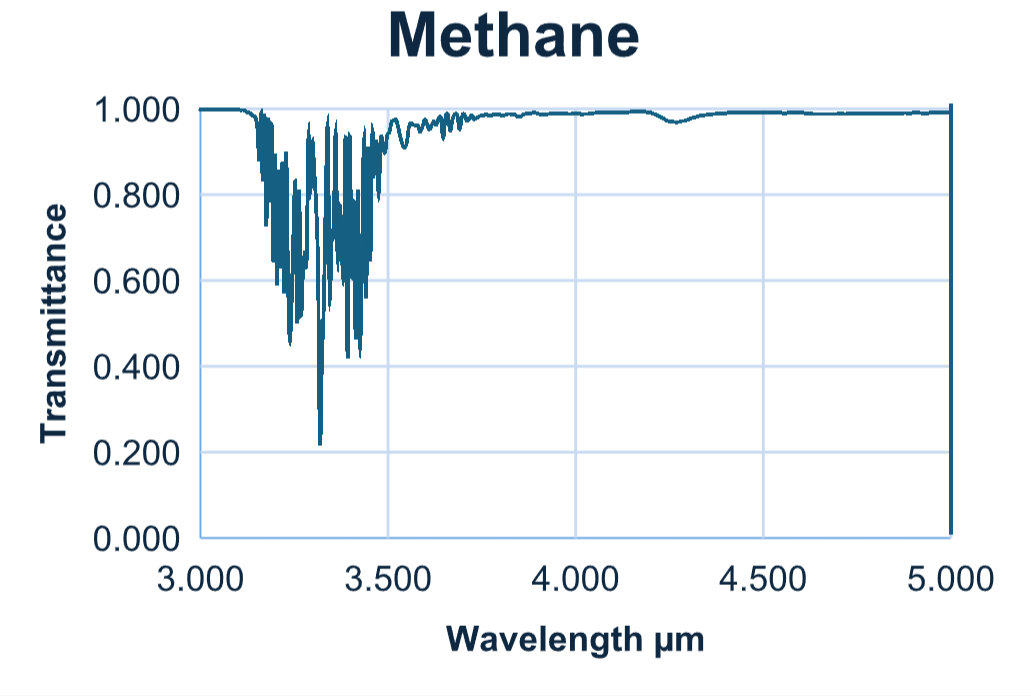
The filter is cooled to the same cryogenic temperature as the detector to minimize its own thermal emission, which could otherwise introduce noise and reduce the camera’s sensitivity. Common filter materials include dielectric multilayer coatings or specialized optical substrates that achieve high transmission in the target wavelength range and high rejection elsewhere.
Infrared energy, which is electromagnetic radiation, does not slow down in the sense of its speed (the speed of light, c≈3×10⁸ m/s in a vacuum) when passing through a spectral filter. However, the interaction with the filter material can affect the effective propagation of the energy in the following ways:
- Refractive Index Effect: When infrared radiation enters a spectral filter, it travels through a medium (e.g., glass or a dielectric coating) with a refractive index greater than 1. The speed of light in the medium is reduced to c/n, where n is the refractive index. This is not a slowdown of the infrared energy itself but a change in the wave's propagation speed due to the medium. For typical infrared filter materials, n ranges from 1.5 to 4 (e.g., 1.5 for glass, ~4 for germanium in infrared applications).
- Phase Delay: The filter may introduce a phase shift in the infrared wave due to multiple reflections or interference within its layers (common in interference filters). This can make it seem like energy is "delayed," but the speed of light itself remains constant within the medium.
- No Net Slowdown of Energy Transfer: The energy carried by the infrared radiation (via photons) is not slowed in terms of its transfer through the filter, though some energy may be lost to absorption or reflection, as described previously. The transmitted wavelengths exit the filter at the same speed they would in the medium.
While the infrared wave's propagation speed is reduced inside the filter material due to the refractive index, the energy itself does not "slow down" in a meaningful way. The filter’s primary role is to selectively transmit, reflect, or absorb specific wavelengths without altering the fundamental speed of the infrared photons.
How the Filter Works
The spectral filter operates on the principle of optical interference or absorption. In a dielectric multilayer filter, alternating layers of materials with different refractive indices are deposited to create constructive and destructive interference patterns for specific wavelengths. The filter is engineered such that only wavelengths within the methane absorption band (e.g., 3.2–3.4 µm) are transmitted, while others are reflected or absorbed.
The filter’s bandpass characteristics are defined by:
- Center Wavelength (CWL): The wavelength at which maximum transmission occurs, typically aligned with methane’s peak absorption at ~3.3 µm.
- Bandwidth (FWHM): The full width at half maximum, which determines the range of wavelengths transmitted (e.g., 100–200 nm for methane detection).
- Transmission Efficiency: The percentage of incident energy at the target wavelength that passes through the filter, often >80% for high-quality filters.
- Out-of-Band Rejection: The ability to block wavelengths outside the target range, typically achieving a rejection ratio of 1000 or higher.
By isolating the methane absorption band, the filter enhances the camera’s ability to detect methane by increasing contrast between the gas and the background. Methane absorbs IR radiation at 3.3 µm, appearing as a dark cloud in the camera’s image against a brighter background, assuming the background emits or reflects sufficient IR energy. A spectral filter, particularly a narrowband filter used in cooled infrared cameras for methane detection, typically looks like a thin, flat optical component, often circular or rectangular, with a metallic or dark appearance due to its dielectric multilayer coatings. It might be mounted in a metal holder or integrated into the camera’s cryogenically cooled dewar. The surface may appear slightly reflective or iridescent under visible light, but its true function is in the infrared spectrum, where it selectively transmits wavelengths (e.g., 3.2–3.4 µm for methane detection).
It should be noted here that Methane is used as an example as it represents the major constituent of Natural Gases. Modern cameras can detect most, if not all, common hydrocarbon gases provided there is sufficient temperature between the gas temperature and the average temperature of the background. Response Factors (RF) are available from FLIR Systems and Providence Photonics. Propane has been assigned an RF of 1.00, gases less than an RF of 0.25 present a challenge in detection.
Effects of Energy Passing Through the Filter
Energy Transmission and Attenuation
When IR radiation from a scene enters the camera, it passes through the cooled spectral filter before reaching the InSb detector. The filter’s effect on the energy can be described as follows:
- Selective Transmission: The filter allows only a narrow band of wavelengths (e.g., 3.2–3.4 µm) to pass, with high transmission efficiency (e.g., >80%). This ensures that the detector receives maximum signal strength in the hydrocarbon absorption band.
- Out-of-Band Attenuation: Wavelengths outside the filter’s bandpass are strongly attenuated, either by reflection or absorption, reducing background noise from irrelevant sources such as solar radiation, thermal emission from objects, or other gases with different absorption bands.
- Radiometric Impact: The filter reduces the total radiant energy reaching the detector by limiting the wavelength range. This trade-off is intentional, as it prioritizes spectral specificity over broadband sensitivity, critical for methane detection.
Impact on Hydrocarbon Detection
The filtered energy reaching the InSb detector contains spectral information specific to methane. When methane is present in the scene, it absorbs IR radiation at 3.3 µm, reducing the intensity of the transmitted light in that wavelength range. This absorption manifests as a darker region in the camera’s image, enabling visualization of methane plumes. The cooled filter enhances this effect by:
- Reducing Thermal Noise: By cooling the filter, its own thermal emission (blackbody radiation) is minimized, preventing additional noise that could obscure the methane signal.
- Improving Contrast: The narrowband filter increases the contrast between methane-absorbed wavelengths and the background, making gas leaks more distinguishable.
- Minimizing False Positives: By rejecting wavelengths associated with other gases (e.g., water vapor or carbon dioxide), the filter ensures that the camera is highly specific to methane.
Practical Implications
The use of a cooled spectral filter has several practical effects:
- Enhanced Sensitivity: The filter’s narrowband design and cooling enable detection of low concentrations of methane, often below 1% of the lower explosive limit (LEL).
- Reduced False Alarms: By rejecting irrelevant wavelengths, the filter minimizes interference from other environmental factors, such as water vapor or temperature gradients.
- Trade-Offs in Field of View and Sensitivity: The filter’s narrow bandwidth reduces the total energy reaching the detector, which may require longer integration times or more sensitive detectors to maintain adequate SNR in low-radiance scenes.
Applications and Benefits
Cooled infrared cameras with InSb detectors and spectral filters are widely used for methane detection in:
- Oil and Gas Industry: Identifying leaks in pipelines, storage tanks, and processing facilities.
- Environmental Monitoring: Detecting fugitive methane emissions to comply with regulatory standards.
- Safety Management: Preventing hazardous accumulations of methane in industrial settings.
The cooled spectral filter is critical to these applications, as it enables precise, real-time visualization of methane leaks, improving safety, environmental compliance, and operational efficiency.
Challenges and Considerations
- Cost and Complexity: Cooling the filter and detector requires sophisticated cryogenic systems, increasing the camera’s cost and maintenance requirements.
- Calibration Needs: The filter’s performance must be regularly calibrated to ensure alignment with methane’s absorption band, as temperature shifts or material degradation can affect the bandpass.
- Background Dependence: Methane detection relies on a sufficient thermal contrast between the gas and the background. In scenes with low IR emission (e.g., cold environments), detection sensitivity may decrease.
Conclusion
Cooled infrared cameras with InSb detectors and cooled spectral filters are powerful tools for methane detection, leveraging the unique absorption properties of methane in the MWIR range. The cooled spectral filter plays a pivotal role by isolating the 3.2–3.4 µm wavelength band, enhancing sensitivity and specificity while minimizing noise and interference. By selectively transmitting energy in the methane absorption band, the filter enables clear visualization of gas leaks, making these cameras indispensable for industrial, environmental, and safety applications. Understanding the interplay between the filter, detector, and incoming energy is essential for optimizing camera performance and addressing challenges in real-world deployment.
REFERENCES
- Vollmer, Michael and Mollmann, Klaus-Peter (2018). Infrared Thermal Imaging, Section 3.2
- Ohman, Claes (2001), Measurement in Thermography, Section 8.3.2